I just wanna share this video… It’s about Sabah Snake Grass. It has been widely used in Malaysia and other Asia countries to treat dampness, heaty conditions, cancer, tumors, uric acid, gout, urinates renopathies (disease of the kidney) and uterine fibroid.
Epilepsy is a disease known as seizures. It is caused by a disturbance in the brain that can be repetitive. The disease can attack all ages. It is a serious affliction and can be fatal.
Epilepsy can occur when there is a sudden electrical discharges in the brain excessively. Usually, it happened in a very short term.
Epilepsy may not involve shaking / real convulsions or sudden movements. Patients may experience unconsciousness for a while, changes in views, or might also there is a strange feeling in the stomach.
Epilepsy may occur several times in a day and it could happen once in a few months.
Types of Epilepsy
There are several types of epilepsy which are having different symptoms, causes and also the way of treatments. However, epilepsy is divided into 2 major categories. Each of the categories has many different types. The categories are:
Partial or Focal Epilepsy
– This type of seizures will begin with an electrical discharge in one limited area of the brain. It occurs in just one part of the brain. About 60% people with epilepsy suffering focal seizures. It can be relate to stroke, tumor, brain infection, or head injury but the actual causes are still unknown.
– The symptoms of partial epilepsy can be easily confused with other disorders. For example, the perception of dreamlike associated with complex partial seizures may be misdiagnosed as migraine headache because it also causing a dreamlike state.
Generalized Epilepsy
– Generalized epilepsy begins with a widespread electrical discharge because of abnormal neuronal activity that involves the both side of the brain at once. Thus, it may cause unconsciousness, fall, or massive muscle spasms. This kind of epilepsy is due to hereditary factors.
– However, you need to remember that not all seizures can be easily being categorized as partial or generalized. This is because the different symptoms experienced by some epilepsy’s patients. So, to make sure whether it is the real syndrome of epilepsy or other disorder, many tests and careful monitoring by an experienced physician is needed.
What should you do if someone with you attacked by the epilepsy?
This video below will show you how to take action when someone attacked by Epilepsy:
P/S: Epilepsy can also be treated. For more information on curing epilepsy, you can visit here;Epilepsy Cure
Cerebral palsy is a syndrome that also known as “brain paralysis”. It can be defined as a group of movements and posture disorder that causing limitations of activity which are attributed to non-progressive disturbances that occurred in the developing fetal or infant brain.
Cerebral palsy can be divided into 4 types and each type has different symptoms:
Spastic Cerebral Palsy
This type of CP is due to the upper motor neuron involvement and may mildly or severely affect the motor functions. It cause tightness in the muscles and making the patients have difficult time to control their movements. It is a syndrome that often suffered by children. It occurs in about 70% of cases. Spastic cerebral palsy syndrome also may produce hemiplegia, paraplegia, quadriplegia or diplegia.
Kids that suffered from spastic diplegia will have difficulty in walking because both of their legs get affected. This will causes the muscles in the hips and legs become tight then turn the legs inwards and cross at the knees called scissoring.
For spastic hemiplegia, only one side of the body gets affected. Usually, the arm is more severe affected than the leg. It is because of the damage to a brain’s part. The risk of hemiplegia is higher in premature babies. Other symptoms for spastic hemiplegia CP are speech difficulties or visual impairment, specific learning difficulties, perceptual problems or emotional and behavioral problems.
Spastic quadriplegia is the most severe syndrome because it affected all four limbs and the trunk. It also affected the muscles that control the tongue and mouth. This will make the patients difficult to speak and suffer from mental retardation. Some children with quadriplegia will experience hemiparetic tremors which is an uncontrollable shaking that affect the limbs and one side of the body.
The causes of spastic paraplegia are progressive weakness and increasing the muscles tone and stiffness of the leg muscles. This will resulting difficulty in walking (frequently stumble and trip), muscle spasms, difficult in balancing and urinary urgency and frequency.
Athetoid Cerebral Palsy
In general, Athetoid cerebral palsy occurs in about 20% of cases. It is results from the damage or injury to the basal ganglia in the midbrain. It maybe because of the incompatibility of the blood type but now it rarely seen.
Slow, writhing and involuntary movements are the usual symptoms of the children with athetoid cerebral palsy. This will affect the extremities or the proximal parts of the limbs and also the trunk. Besides that, jerky, abrupt and distal movements may occur to the children. These are the symptoms that cannot be avoided.
Moreover, emotional tension will increase the movements of the kids and it will disappear during sleep. Other symptom of athetoid cerebral palsy is the children may suffer from dysarthria. This term also known as speech disorder. Children with athetoid cerebral palsy often experience speech difficulties.
Trouble in holding themselves in an upright, steady position for sitting or walking, and often show a lot of face, arms, and upper body movements are also the symptoms of the athetoid cerebral palsy kids. They do not mean to do that but the movements occur by its own with random and involuntary movements.
Because of their mixed tone and trouble keeping a position, they are unable to hold onto things such as fork, toothbrush or pencils. To get their hands to a certain spot likes reach for a cup or scratching their nose also takes a lot of work and concentration to do.
Ataxic Cerebral Palsy
For ataxic cerebral palsy syndrome, there are about 10% of cases that occur. Because of weakness, in-coordination and intention tremor, a wide-based gait, unsteadiness and difficulty with rapid or fine movements are produced.
The clear symptoms that can be seen for this type of cerebral palsy are jerky or low muscles tone and uncoordinated movements. Besides, having problem with balancing and depth perception makes they unsteady when walking.
They also may have hard time to control their hands or arms when they reach for something or when they are writing because they always appear shaky or tremor.
Mixed Cerebral Palsy
The symptoms of mixed cerebral palsy are not uncommon. It is a combination of all the above types of cerebral palsy. But it is most often of mixture of the spasticity and athetoid movements because they have tight muscle tone and involuntary reflex.
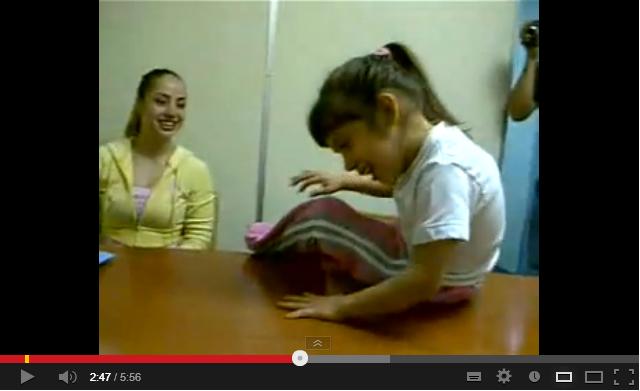
Watch this !
[This video taken during a Cerebral Palsy kid undergoing acupuncture treatment at The Tole.]